

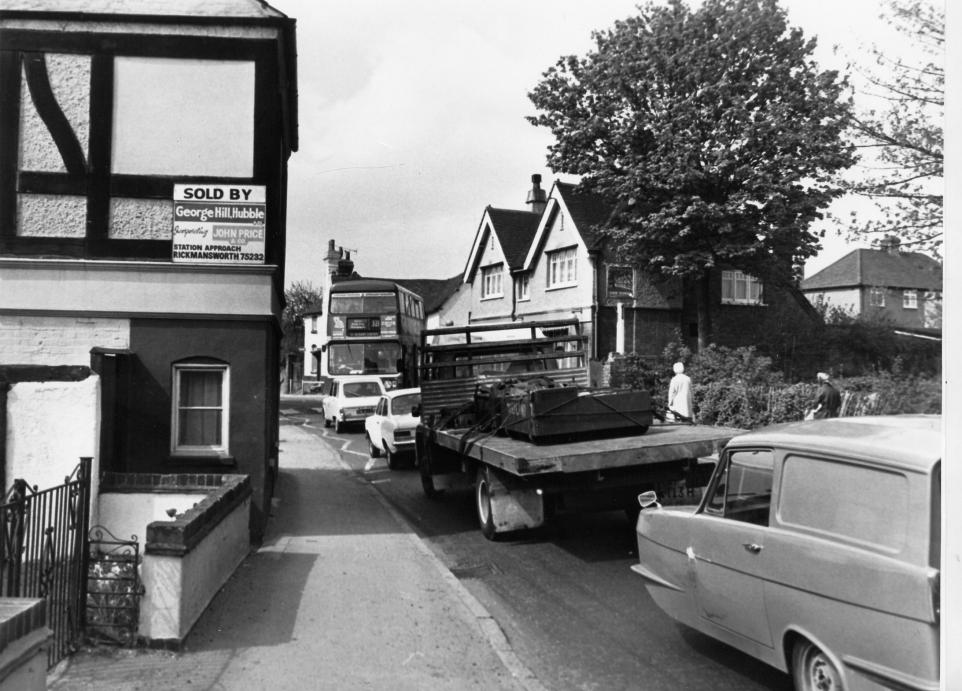
Interesting and rich past of Mill End in Rickmansworth.
Fabian Hiscock, chairman of the Three Rivers Museum Trust, discusses why the story of a specific place in Three Rivers is important in and of itself.
Mill End is an interesting area of Three Rivers, located on the outskirts of Rickmansworth and frequently passed by on the way to the M25. However, it has its own tale, which readers and locals will remember.
It is unclear why it was named Mill End, but it was surely so before the end of the 15th century, most likely before there was a mill – a local landowner gave two houses there in 1497, and in 1588, the residents attempted to shut down a disorderly ale establishment.
Nonetheless, there was a water mill there by the middle of the 18th century, which by 1755 had become one of several paper mills in the area – it made ‘fine paper’ by hand, though by 1835 it was most likely using water-powered machinery and drying the paper with coal-produced steam (the chimney can be seen in a few local photographs). It closed and was dismantled around 1910.
The Royal Herts Laundry was built around 1910 on the site of the former Wilds brewery.Image:
Three Rivers Museum. of addition to the ordinary stores and small enterprises of a village like Mill End, the Wild family controlled two small industrial sites in the nineteenth century: a tannery and a brewery.
Sedgwicks purchased and shuttered the brewery in 1900, making way for the mineral water industry, which later relocated to Springwell, and the Royal Herts Laundry.
Before World War One, the tannery was sold to W & A Galley and converted into a leather factory that produced boots and leggings for the army.
Horwoods were builders and coal merchants, but they also hired steam-powered road rollers. Tornado sports cars were constructed on what is now Fairway Tyres’ facilities.
The Rickmansworth and Uxbridge Valley Water Company pumping station was constructed in 1888 and dismantled in 1966.And we’ve already covered the Crown Offices at Moneyhill’s end, as well as the watercress beds that are so common in this area.
Uxbridge Road, Mill End, 1907 – mill chimney to the left of centre. Image: Rickmansworth Historical Society/Geoff Saul Collection. There have, of course, been houses of worship and learning.
The Methodist church is on Berry Lane, and the Baptist church built and used the Ebenezer Chapel from 1823 until 1946, when they relocated to Field Way.
St Peter’s parish church was completed in 1875 and has housed a school since 1880.York House School held Moneyhill House from 1950 until it relocated to Croxley Green, and a new senior school was completed in 1936.
Mill End Mill – the waterwheel pit, around 1990. Image: Rickmansworth Historical Society/Geoff Saul Collection. Despite the limited industrial establishments, agriculture was the primary occupation.
Until around the end of the nineteenth century, the majority of the land was used for farming, and this continued until after World War II.
Shepherds, Two Stones, Mill End, and Long Lane Stockers Farms owned territory along the Uxbridge Road between Parsonage and Woodoaks, employing a large number of people.
The’metroland’ and later development of the residential roads to the north of Uxbridge Road removed the majority of that, but it also provided us with the rich variety that we love so highly today. Mill End’s tale is important in and of itself.
Uxbridge Road, Mill End, c1910: the Vine and Horwoods on the opposite side. Image: Rickmansworth Historical Society/Geoff Saul Collection.
Three Rivers Museum is open Wednesday through Friday from 2 to 4 p.m., and Saturday from 10 a.m. to 2 p.m. For further information, please
Read more on Straightwinfortoday.com

Comments are closed, but trackbacks and pingbacks are open.