

Disused Stations: Uxbridge Vine Street
Station
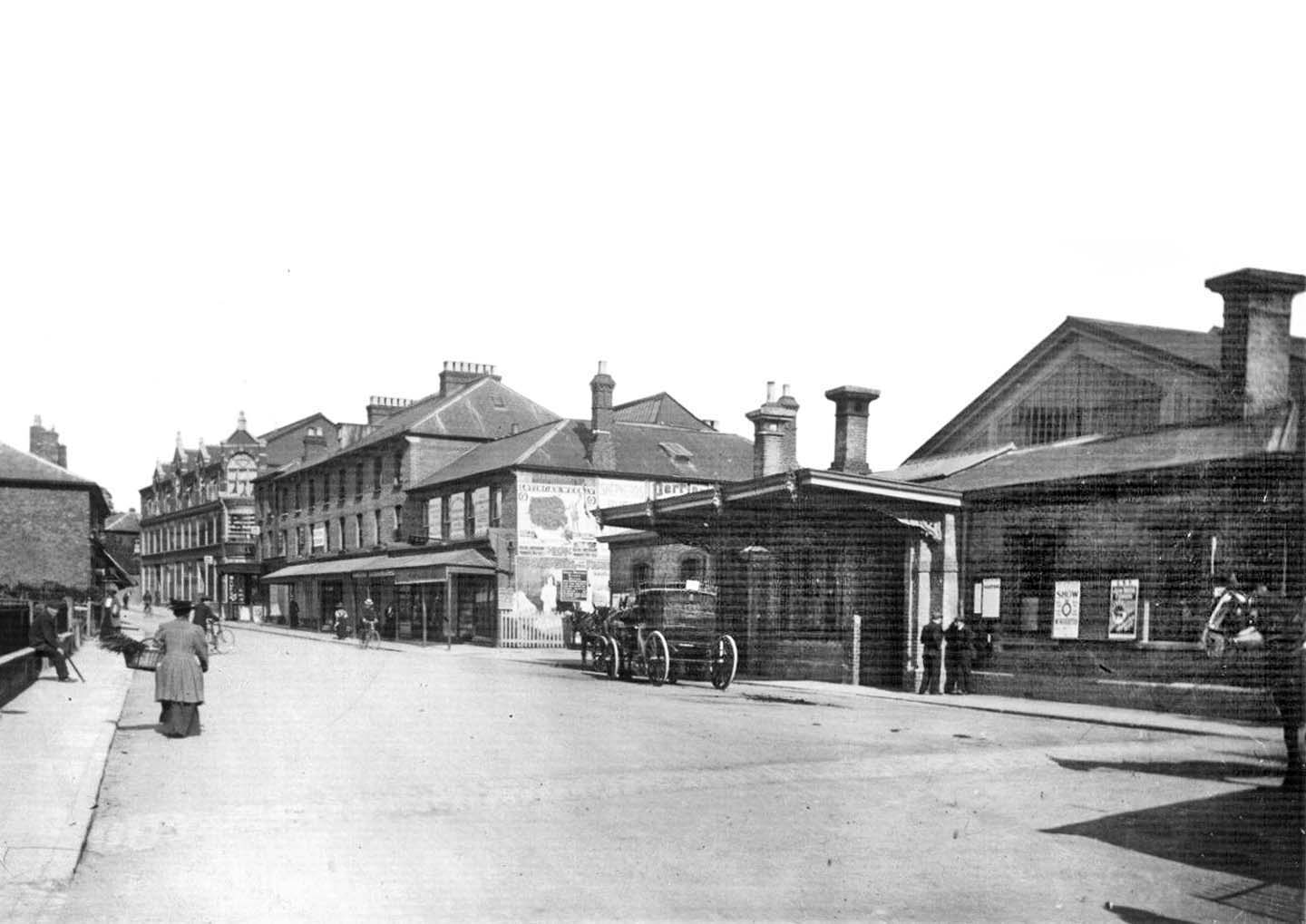
Looking down Vine Street toward High Street at the turn of the twentieth century.
The Vine Street station is on the right, while the jumble of small buildings at the goods yard entrance is concealed on the far right. The exquisite building in the left background is the original Randalls department store, which opened in 1891.
This structure was replaced by the current one in 1937, and it sadly closed its doors for the final time in 2015. Randalls gained notoriety during World War II for airing advertising that many people considered to be pro-Nazi.However, there was more to come as the camera captured the lady on the left carrying her wicker basket.
Her attire, which dragged on the road surface, was not so much a fashion statement as it was a reflection of the morality of the time, which stated that no part of a woman’s body below the neck could be exposed in public because it was indecent.Almost every railway station, including halts, had an inn nearby. Uxbridge Vine Street was
Unfortunately, the inn is not visible from the left. Its history varies depending on the source, however it was once called The Swan before becoming the Railway Hotel when the railway arrived. It was renamed The Railway Arms in 1930 and has also been referred to as The Railway Inn, most likely because it appears as a ‘inn’ on some maps. The establishment survived the railway shutdown to Vine Street and was renamed ‘The Printer’s Devil’ in 1976. Perhaps it goes without saying that the structure is no longer there, having been razed during the 1990s neighbourhood rebuilding.
The building that became the Electric Cinema in 1910 and was later transformed into the Uxbridge Fire Station was obscured by the railings on the left.
It, too, is no longer around.At the time of this photograph, road motor transport was still in its infancy, restricted for a select and adventurous few.
Aside from the train, people travelled on foot, bicycles, or horse-drawn vehicles. During this time, most trams and buses were still drawn by horses. The Brougham parked outside the station was typical for its day.
Uxbridge was clearly well connected by railways at the time the photograph was taken.Otherwise, and in due course, the London General Omnibus Company had four bus routes, but the Uxbridge garage was in Denham.
At least one of ‘The General’s’ bus lines, to Slough, passed through Vine Street Station. London United Tramways opened its electric tram route Uxbridge in 1901, as an extension of its existing Southall route. Route 7 was numbered and ran to Shepherd’s Bush until London Transport took over, at which point ‘Feltham’ class trams dominated the route.
In 1936, the trams were replaced by the 607 trolleybus, which mostly followed the same route. Trams and trolleybuses served Uxbridge exclusively along High Street, with stops near the former High Street railway station.The 607 trolleybus became the 207 motor bus route.
Thus, while Vine Street station was only a short walk from High Street, it was located outside of Uxbridge’s primary public transport hub.Interestingly, Transport for London has re-established a 607 service, although with motor buses, but whether the route number was intentional or coincidental is debatable.
As of 2018, Vine Street has the 427 route that connects York Road (Uxbridge Station) and Acton (Old Town Hall). Photo from the Richard Casserley collection.
Read more on Straightwinfortoday.com

Comments are closed, but trackbacks and pingbacks are open.