

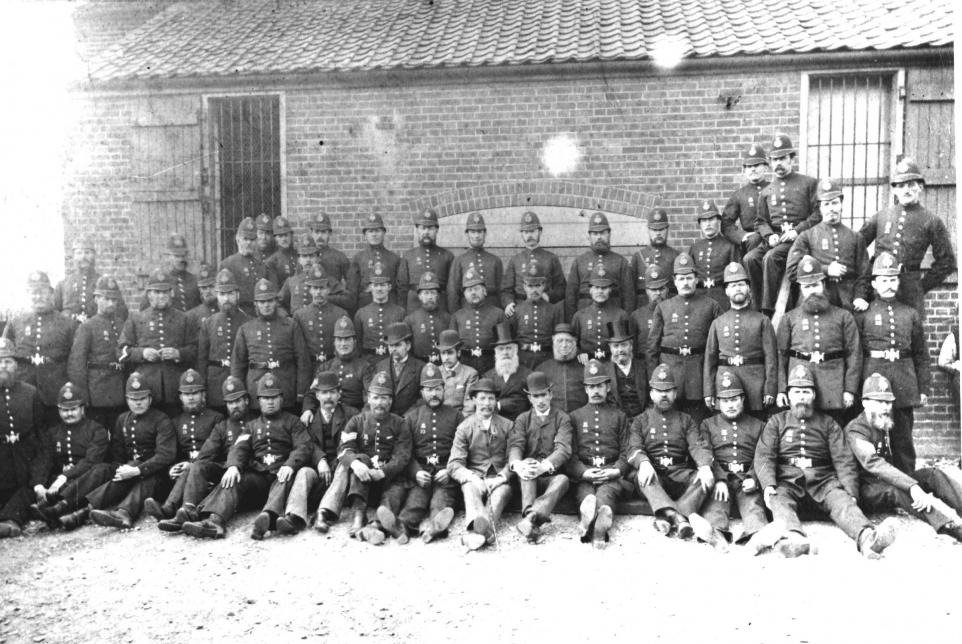
Richard Bryan with memories of the county’s first police.
190 years ago, a decision was made to establish permanent police forces in 178 boroughs, including four in Norfolk.
Norwich, Kings Lynn, Great Yarmouth, and Thetford.
At the time, we lived in what could be dark and dangerous places, and it was in 1820 that people gathered at Norwich’s Guildhall to demand a police force to protect them, claiming that highway robbery, burglary, and smuggling were common, and that the “watchmen” of the day couldn’t stop them, but if they did, there was a reward.
Egbert Napier. Chief Constable of Norfolk 1909-1915 (Image: force archives)
The city and county experienced a record amount of crimes. Wymondham was described as “disorderly and turbulent in the daytime” and “populated by thieves and plunderers at night.” And in 1786 an organisation was established that stated:
“The parish of Aylsham has been lately very much infested by a set of disorderly persons, who made a practice of breaking down rails and fences, robbing gardens, stealing wood, turnips, poultry and committing divers other acts of felony, which chiefly arise from want of public prosecutions and some time from the inability of the prosecutors.”
Robert Hitchman was Norwich’s first indisputable Chief Constable, serving for a record 38 years (1859-1897). He was referred to as a “gentleman.” (Image: Force Archives) Annually, 41 people paid up to “put a stop to such growing evils.”
Smuggling was also a substantial business, with large amounts of stolen wine and tobacco being transported. In 1833, armed smugglers clashed with coastguards in Cley-next-the-Sea.
Public hangings on Castle Hill in Norwich did not discourage criminals. They also drew large crowds; it was a time to celebrate and drink. The pickpockets had a field day.
The Municipal Corporations Act of 1835 established police units in Norfolk’s largest boroughs.
Norwich police HQ known to one and all as the “tin hut” in the city. They are not police vehicles in the photograph taken in the 1930s.
The site was also a public car park run by the Royal Norfolk Volunteer’s Association (Image: Newsquest archive)
The towns and villages were left to defend themselves for the time being.
New policemen were to be aged between 25 and 50, be at least 5ft 6in tall and in good health.
Pay for the constables was 15 shillings (75p) per week with 1 shilling (5p) stopped for clothing although they had to provide their own trousers.
Sergeants got an extra 2/6d from 1937.
Arthur Cooper Claxton. A giant of a man who joined the Norwich force in 1886 and was said to be the only police constable prepared to patrol rough and tough Ber Street in the city, unaccompanied (Image: B Huntingdon)
They were issued with a dark blue swallow-tailed coat, a leather top hat, greatcoat, cape, belt, lanthorn, truncheon, rattle and handcuffs.
Whistles and notebooks would follow.
And so they stepped out to face the public in a tough and violent world.
In Norwich disturbances and riots were commonplace.
Many families lived in slums with no running water and little street lighting.
At King’s Lynn Constable John Woods was appointed Superintendent.
His pay was £1 a week plus a house while in Thetford the superintendent was told to: “patrol the town for the purpose of suppressing vagrancy and to inspect the public houses and beer houses, to see that they close at proper hours, likewise during Divine Service on Sundays and to apprehend all disorderly persons.”
Meanwhile in Great Yarmouth two superintendents were appointed, along with 15 watchmen and policemen, to serve in the police station at the Gaol House at Middlegate.
So equipped, and not altogether welcome, they went forth to battle against the forces of lawlessness and disorder.
There were no rest days or holidays.
Many of the officers turned to alcohol.
Ale was cheap and freely available.
There was a report of a constable watching over the turnpike road between King’s Lynn and West Winch because of a string of robberies.
He got involved in a violent fight with two suspects and when the punch-up was over all three went off to a tavern to have some drinks.
He knew the two men.
Many of these stories are told in a book about the history of Norfolk police by former Superintendent Brian Butcher published in 1989 including the following one we report as written:
Captain George Black who was elected by magistrates as chief constable of the Norfolk force in 1852 with senior officers in 1880 (Image: Force archives)
A rural policeman wrote: “One evening, we went out together on our beat, which included a gentleman’s home.
He explained, ‘Now I’ll teach you how to get a drink of ale.’ We used to carry gloomy lanterns. ‘Blow out your light.’ I did this, and he did the same.
“We then proceeded to the door of the mansion’s servants’ hall and respectfully asked one of the maids to give us a light, as our lamps had burned out, which he assumed was due to poor oil.
The butler cordially let us in, trimmed our lights, and then asked, ‘Will you want a horn of ale?’ “Of course, we answered ‘Yes,’ and received it accordingly.
We started over on our journey, and he nudged me with his elbow, saying, ‘That’s how you get a drink when you want one.'” As Brian points out, such anecdotes provide an interesting peek into the officers’ personalities but do nothing to reflect the realities of their lives.
They were paid a wage that put them on the verge of poverty, and they worked hard under difficult conditions.
More to come. Former policemen have recently produced two essential and entertaining books about the history of the city and county’s police forces.
In 1989, Supt Brian Butcher published A Moveable Rambling Police: An Official History of Policing in Norfolk, and in 2000, the late Maurice Morson, former Head of Norfolk CID, wrote A Force Remembered: The Illustrated History of the Norwich City Police 1836-1967.
Read more on Straightwinfortoday.com

Comments are closed, but trackbacks and pingbacks are open.