

Uxbridge Vine Street Station Gallery 2:
c early 1930s – 1958.
Related Posts
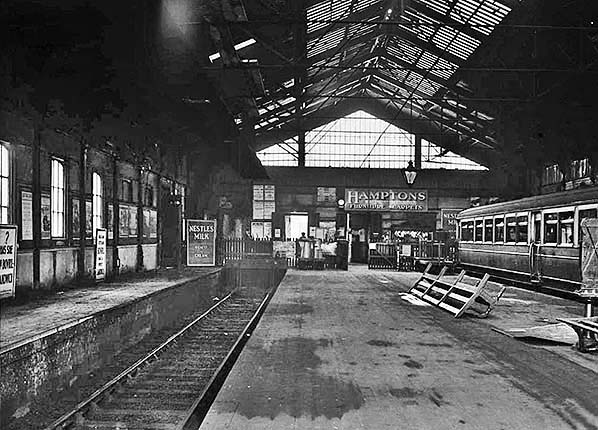
Inside the train shed on Vine Street in Uxbridge, just before it was destroyed in 1932/3. Only two sides of the brick-faced, wood-surfaced island platform were intended for passenger use. The small platform on the far left was only for workers, but there was another similar platform on the far right, hidden behind the autotrailer. The bench was allegedly reversed to prevent people from sitting on it, but the reason was not specified.
Some milk churns can be seen in the background, and the station was well-advertised for the time. Two Nestles Milk logos are seen. The autotrailer is either a Diagram L or a Diagram P vehicle; in either case, these 70-foot-long vehicles were built fresh as trailers and were not converted from steam railmotors. The driving cab is facing the bufferstops, and at the opposite end, out of sight to the right, there is a luggage compartment. The only passenger entrance was a doorway on either side that went into a vestibule.
Retractable steps and grabrails are provided for use at ground level stops. Photo from the Jim Lake collection.
![]() Looking up the platform at Uxbridge Vine Street towards the shadow of the decrepit-looking trainshed shortly before it was dismantled in 1932/3. Outside of the trainshed the platform was paved, at least towards its faces, but on the left where the three men are standing can be distinguished the point at which the platform surface becomes wooden.The platform on the far left was not intended for passenger usage, nor was the counterpart out of view on the far right.
Looking up the platform at Uxbridge Vine Street towards the shadow of the decrepit-looking trainshed shortly before it was dismantled in 1932/3. Outside of the trainshed the platform was paved, at least towards its faces, but on the left where the three men are standing can be distinguished the point at which the platform surface becomes wooden.The platform on the far left was not intended for passenger usage, nor was the counterpart out of view on the far right.
street_old24.jpg) Looking up the platform at Uxbridge Vine Street towards the shadow of the decrepit-looking trainshed shortly before it was dismantled in 1932/3. Outside of the trainshed the platform was paved, at least towards its faces, but on the left where the three men are standing can be distinguished the point at which the platform surface becomes wooden.The platform on the far left was not intended for passenger usage, nor was the counterpart out of view on the far right.
Looking up the platform at Uxbridge Vine Street towards the shadow of the decrepit-looking trainshed shortly before it was dismantled in 1932/3. Outside of the trainshed the platform was paved, at least towards its faces, but on the left where the three men are standing can be distinguished the point at which the platform surface becomes wooden.The platform on the far left was not intended for passenger usage, nor was the counterpart out of view on the far right.The autotrailer is another truck from Diagram L or Diagram P, but this time the driver’s cab faces West Drayton. There was probably a locomotive in the trainshed. The driver’s brake valve can be seen behind the windscreen, nearest the camera; it was positioned vertically and functioned in a left-to-right direction. The huge circular gadget above the windscreen is a warning gong. The mechanism partially visible above the center windscreen is the regulator mounting, which was controlled by a long vertically mounted lever. Photo from the Jim Lake collection.![]()
street_old28.jpg)
Looking south at the Uxbridge Vine Street station in 1930. The goods shed can be seen to the east of the trainshed, with a substantial coal yard to the south of it. The Thorpe Brothers coal merchant’s office is visible at the entrance to the goods yard in the form of a small, angled building. Photo of Britain from Above, copied with permission.
street_old25.jpg)
This shot of Exbridge Vine Street station’s modest forecourt was taken somewhere between 1931 and 1933, or very shortly after.’General’ Dennis Dart DA 22 (GK 5441) is waiting outside the station on route 506 to Staines via Cowley and Wraysbury. There are other bus routes that connect Uxbridge and Staines today, but none of them follow the path of the old 506. Nearly a century ago, the situation at Uxbridge was nearly another universe; on the one hand, there was and still is the Metropolitan and Piccadilly trains into and beyond Central London, while on the other,
Vine Street Branch (and High Street Branch) for which an autotrain or railcar sufficed for a long time, together with a lovely small 18-seater One-man-operated buses serve the semi-rural outskirts of west London. Click here to get a more full caption. Photo from the Jim Lake collection.
![]()
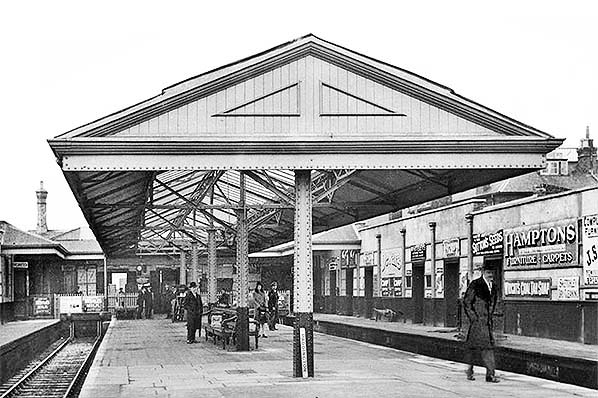
The trainshed roof at Vine Street was removed in 1932/3 and replaced with the unbrella awning seen here. The canopy is immaculate and, along with the fashion styles, it is likely to have been taken shortly after the canopy was erected. We are afforded a relatively clear glimpse of the two outermost platforms, neither of which were normally used by passengers. It is not unreasonable to assume that the platform on the right was used by pass.
A set of destination boards leaning against the canopy stanchion nearest the camera, one of which announces ‘Paddington’. These boards were for rolling stock, not platform indicators.A suspended gas lamp can be seen between the second and third stanchions, and a drop dial clock is mounted on the far wall, directly in front of the camera. Kays, the same folks that created the catalogue and used to manufacture clocks and watches, supplied Great Western Railway station clocks.
Clocks were among the few things not manufactured by the railway at Swindon. Vine Street station was well-stocked with vivid enamel ads, as one would anticipate given the time era. Most of the brands are familiar, such as Nestle’s Milk, Camp Coffee, Wright’s Coal Tar Soap, Sutton’s Seeds, and Sketchley Dry Cleaning. The person on the right is marching purposefully along the platform, implying that he may have been a railway official.
It appears that there were more employees than passengers on this occasion, which is not surprising given that a railmotor or autotrain sufficed outside of peak hours. The few passengers on the platform appear to be waiting for a train on the up side of the island platform. Photo from the John Mann collection.![]()
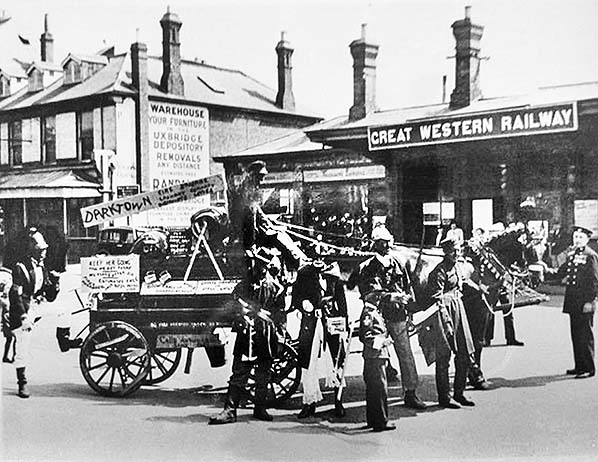
Despite significant inquiry, little can be explained about what is happening in this shot taken outside Uxbridge Vine Street station.What we appear to have is a fund-raising event with a horse-drawn fire pump modified for the pouring of ale. The automobile in the left background suggests that the time period is the 1930s or possibly during World War II. The answer could be found in the several crudely crafted placards on the horse-drawn truck, but sadly, very little is readable. It was most likely some kind of fund-raising event.
Read more on Straightwinfortoday.com

Comments are closed, but trackbacks and pingbacks are open.