

The Battles of Mowmacre Hill.
Having lived in Leicester for 66 years, I had assumed that the city and county held few surprises for me. I didn’t think I knew everything, but I thought I had a better than average understanding of local history.
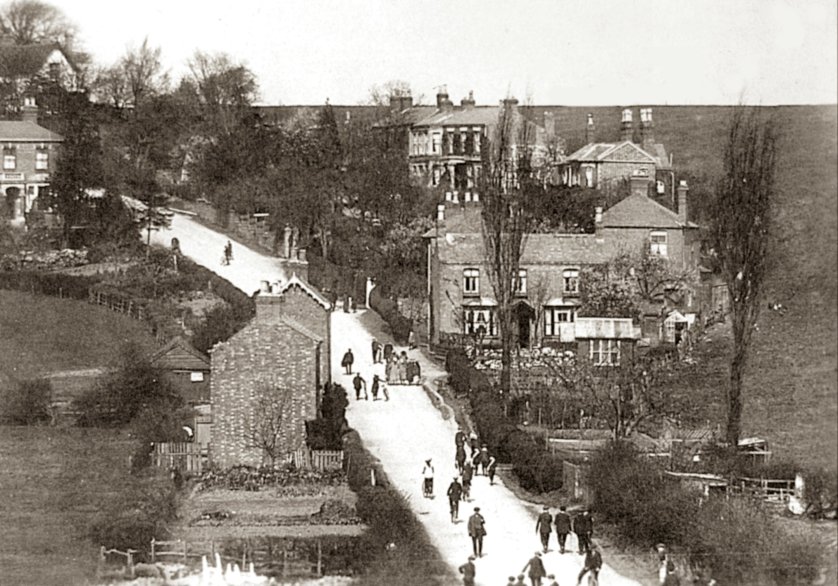
However, a few months ago, I came upon a story about the Battle of Mowmacre Hill, which occurred in 1842. I’d always considered of Mowmacre Hill as just a very steep rise on Thurcaston Lane to the north of the city, with no special significance. As a result, I resolved to research the event to learn as much as possible about what transpired.
The 1840s, as well as the preceding and succeeding decades, appear to have been a period of extreme poverty in Britain, prompting the formation of the Chartist movement and frequent strikes by workers in various industries.
In Leicester in 1842, miners became the first to strike. Their grouse was that, while being limited to working only half a week, they were obliged to pay a full weekly rent for the framework knitting machines that they used in their homes to supplement their salaries. Naturally, this resulted in enormous difficulty and bitterness.
In the same year, Thomas Cooper* came in Leicester. Cooper, who was born in poverty in Leicester, grew up in Lincolnshire and received an education far beyond his means. He had previously worked as a journalist in Lincoln before briefly joining the Leicester Mercury.
As a young and dynamic Chartist speaker, he quickly became a passionate advocate for the local miners, inspiring them to take militant action in the shape of protest marches and processions.
In August, a group of miners led by Cooper marched to Loughborough to join another group of demonstrators.
When they arrived at Mowmacre Hill, they were confronted by Frederick Goodyer, the county police head, who was backed up by the constabulary and the local Yeomanry.
There appears to be no definitive information as to what happened when the two sides met, although the march appears to have ended pretty swiftly, with no mention of any casualties other than a bullet wound to the nearby pump. However, it has been reported that anytime a member of the yeomanry came in Leicester, there were yells of “Who shot the pump,” implying that weaponry were discharged inaccurately.
Perhaps a more ferocious conflict was rumoured to have occurred on Mowmacre Hill in the 1890s. Not only was the second conflict more brutal, but its roots were more cultural and theological than anything else.
The tale goes like this: In the 1890s, the Great Central Railway began work on its expansion from Sheffield to London via Nottingham, Leicester, and Rugby, with the Leicester section passing close to Mowmacre Hill.
As was customary at the period, a large number of workmen (Navvies) were engaged to build the line.
These labourers came from a variety of nationalities, primarily English, Irish, and Scottish, all of whom were known to be strong drinkers in their spare time, such as it was.On this particular occasion, it appears that the English and Irish contingents concluded that their Scottish colleagues were heathens or at least un-Christian because they did not celebrate Christmas* and would benefit from a good “duffing up”. As a result, the mother and father of all fights broke out, with the English and Irish contingents plunging into the Scots.
The forces of law and order, sent to the site to calm the disturbance, chose, for whatever reason, to simply observe the proceedings until tiredness overtook the combatants, at which point they moved in to do what was necessary.
So concluded the second Battle of Mowmacre Hill. I do not believe each occurrence teaches any moral lessons; rather, these incidents give colour to our city’s history.
Read more on Straightwinfortoday.com

Comments are closed, but trackbacks and pingbacks are open.